
EPCs evaluating controller platforms for ESI-enrolled batteries are weighing a ten-year decision against a program with hard compliance gates, clawback exposure, and stacked value streams. This document lays out the Sponge controller specification, the feature set relevant to ESI, and the engagement model — so the technical and commercial decision can be made on the same page.
Executive summary
EPCs are evaluating controller platforms to manage behind-the-meter battery energy storage systems enrolled in the BC Hydro Energy Storage Incentive (ESI) program, with projects in the 200 kWh to 5 MW class. The economic case for these systems depends on three things working reliably over a ten-year horizon:
- ▸Consistent dispatch response to BC Hydro — missing the 85% threshold triggers clawback and compromises the project's economics.
- ▸Continuous demand charge reduction — the primary ROI driver outside of the incentive itself, and the value stream most strongly linked to controller performance.
- ▸Low operational overhead — for both O&M teams and the end customer, over a deployment life measured in years rather than months.
Sponge is purpose-built for this problem. Our Energy Management Controller (EMC) runs a Model Predictive Control (MPC) framework at the edge, rather than a rules-based dispatch schedule — the controller adapts to real conditions at each site rather than being tuned once at commissioning and drifting out of alignment. For a program like ESI, where dispatch compliance must coexist with ongoing demand charge optimization and seasonal load variation, MPC is critical to meet economic performance requirements, and delivers materially more value than rules-based dispatch.
Where Sponge adds further value is in how we have specialized that architecture for the ESI program specifically — in our paired economic analysis engine, engineering phase and FMEA support, and in our proximity to the BC Hydro and Uplight program teams as a Canadian operator.
- ▸A controller that meets every ESI minimum requirement — DERMS integration with Uplight AutoGrid Flex, dynamic demand limit management, edge-compute dispatch, zero feed-in control.
- ▸Forecast-based multi-objective optimization — the controller balances ESI compliance with demand charge reduction and solar self-consumption, rather than forcing a choice between them.
- ▸Broad hardware compatibility — native integrations with major inverter and battery OEMs, plus native and custom options for load control and EV charging.
- ▸A partner, not just a vendor — productized proposal service producing full-year simulated economics per site, and ongoing performance review of the deployed fleet.
- ▸Canadian team, BC-adjacent support — Toronto-based, with direct relationships to BC Hydro's ESI program team and Uplight's technical contacts.
ESI program fit: meeting the minimum requirements
The ESI program's minimum performance requirements are non-negotiable: missing them creates clawback exposure that compromises the economic case for the entire project. Each requirement below maps to a specific Sponge capability.
2.1Integration with BC Hydro DERMS for dispatch response
The Sponge EMC integrates with Uplight's AutoGrid Flex platform via the Flex Message Bus (Apache Kafka). The EMC receives dispatch requests, incorporates them as hard constraints in its control horizon, and dispatches the battery accordingly. We have already confirmed communication methods with Uplight and mapped the end-to-end enrollment workflow — SCADA tag list, DERMS Connectivity Request Form, and Asset Control Testing procedures. The full enrollment workflow diagram in Appendix A walks through the sequence including the incentive payout milestones (50% on delivery, 25% on approval to energize, 25% on DERMS integration).
2.2Dynamic demand charge limit
With Sponge, demand thresholds are recalculated continuously rather than set at commissioning. The controller adapts to monthly and seasonal variation, to load profile changes from new equipment or operational shifts, and to deviations from baseline that would otherwise cause a static threshold to be set too conservatively. Section 03 explains the mechanism in more detail. The practical result: the customer captures the full achievable demand savings in each billing period, not the lowest-common-denominator savings a single fixed threshold would permit.
2.3High-availability operation
ESI dispatch compliance requires response to at least 85% of calls across a rolling measurement period. The Sponge EMC is designed around edge-local autonomy: dispatch decisions are computed on-device and do not require an active internet connection to execute. The EMC Pro+ hardware package includes a cellular router with optional redundancy for BC Hydro's >5 MW redundancy requirements, and an Industrial PC with watchdog functionality that ensures controller uptime. These are standard features of the Pro+ package, not custom engineering. Section 04 describes the fail-safe architecture in more detail.
2.4Zero feed-in control
The ESI program specifically compensates non-exporting battery storage projects. The selected control platform must therefore modulate battery power to follow facility load during dispatch events, ensuring that the battery does not export to the grid while responding to BC Hydro's dispatch signal. This is an established capability of the Sponge EMC. The EMC reads export power at the point of interconnection via a revenue-grade meter and adjusts battery power in real time to prevent backfeed. This is included as a standard and configurable feature on every Sponge EMC.
Model Predictive Control architecture
The core of the Sponge controller is a model predictive control (MPC) framework that re-optimizes the battery dispatch plan every 2–10 minutes (configurable per site) based on updated forecasts of load, solar generation, electricity price, and pending grid events. Rather than executing a pre-programmed schedule or a threshold-triggered logic tree, the controller solves for the least-cost dispatch path across the forecast horizon subject to the costs, constraints, and value streams active at the site.
This matters because the economic performance of a battery in a program like ESI depends on three things happening simultaneously, not sequentially:
- ▸Responding to BC Hydro dispatch events at the required compliance rate.
- ▸Managing demand charge exposure on a rolling basis under variable load.
- ▸Capturing value from solar self-consumption where applicable, without compromising the first two.
A rules-based controller requires the system integrator to pick one of these to optimize for and accept that the others will be handled sub-optimally. An MPC controller can pursue all three simultaneously, trading off between them based on which yields the most value at any given moment.
3.1How the control loops work
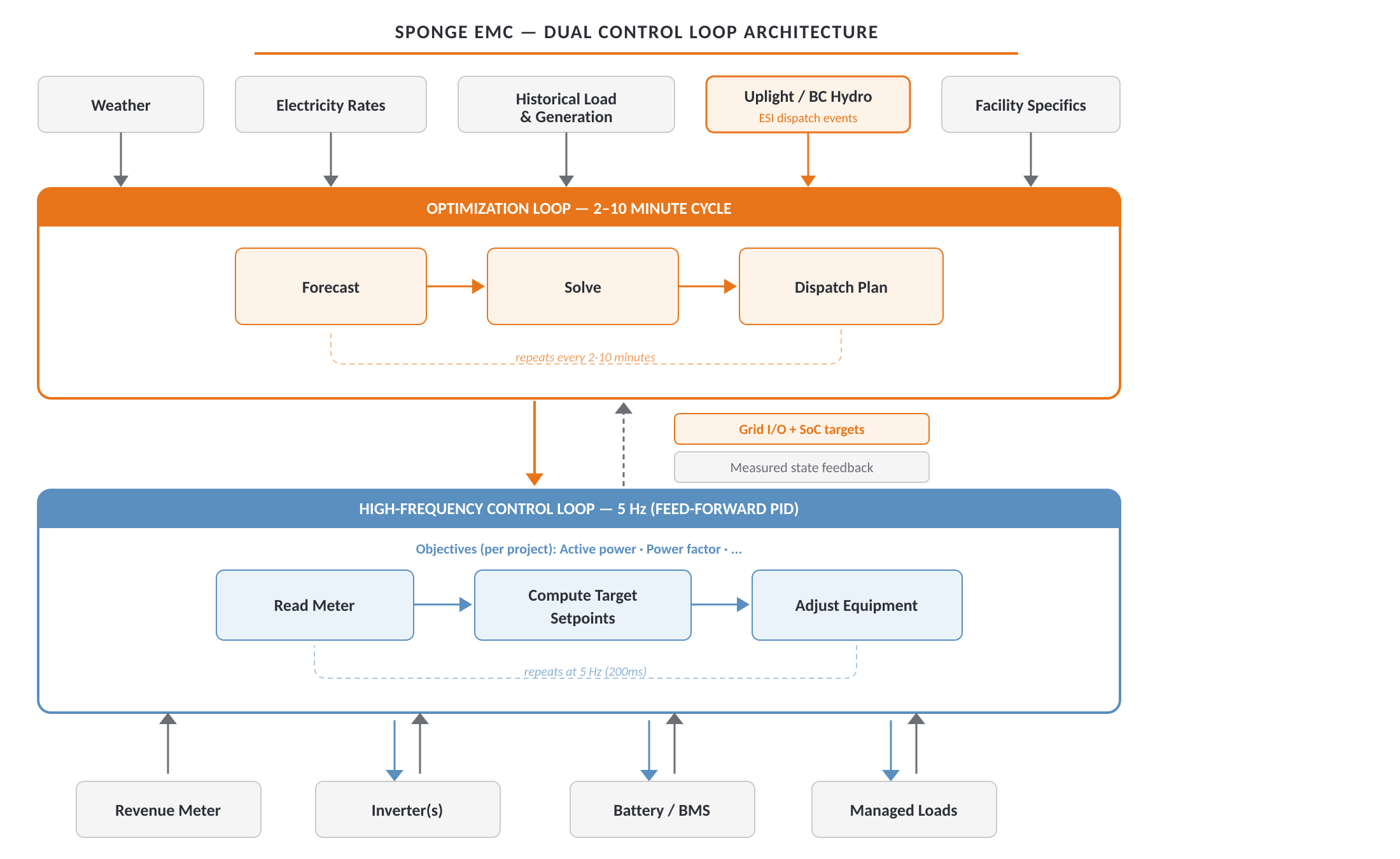
The Sponge EMC operates two distinct control loops, each responsible for a different aspect of dispatch:
Optimization loop — 2–10 minute cycle
Every 2–10 minutes (configurable per site), the EMC executes the following sequence:
- 01Forecast. The EMC generates updated forecasts for site load, solar production (using weather data), grid electricity pricing, and pending ESI dispatch events received from Uplight.
- 02Solve. The optimizer computes the dispatch plan (charge/discharge setpoints across the horizon) that minimizes total cost — including demand charges and energy charges — subject to hard constraints (ESI response, SoC bounds, inverter power limits, export permit).
- 03Execute. The optimizer produces grid import/export power and state-of-charge profile targets and passes them to the high-frequency control loop for real-time execution.
- 04Repeat. The cycle runs again with new information — load actuals replacing load forecasts, weather updating, dispatch events arriving or clearing. The optimization interval is programmable per site.
High-frequency control loop — 5 Hz
Between optimization cycles, the EMC's high-frequency control loop takes over and actively manages power outputs from inverters to achieve the grid import/export targets set by the optimizer. This loop runs a feed-forward controller at a rate of 5 Hz, reading real-time power flow from the revenue meter and adjusting inverter setpoints to track the target precisely. This is what allows the EMC to maintain zero-export compliance, respond to load transients, and hold demand below the threshold — capabilities that a 10-minute optimization cycle alone cannot deliver.
The high-frequency loop is not required on every project. On installations where the inverter's own internal power control can manage the setpoint, the EMC operates in setpoint-advisory mode and the optimization loop alone is sufficient. On larger commercial and industrial projects — including the 1–5 MW ESI deployments under consideration here — the high-frequency loop is typically required and is a standard capability of the EMC.
3.2Why this matters for demand charge reduction specifically
Demand charge reduction is the largest non-incentive value stream in most ESI projects. Its performance is highly sensitive to how the controller handles two problems.
The threshold-setting problem
Most battery controllers require a monthly or seasonal demand threshold to be set in advance. Set it too low, and the battery runs out of energy mid-peak, exposing the customer to a higher demand charge than they would have paid without the battery. Set it too high, and savings are left on the table. Because load profiles shift with seasons, production schedules, new equipment, and occupancy changes, a threshold that was optimal at commissioning becomes sub-optimal within months.
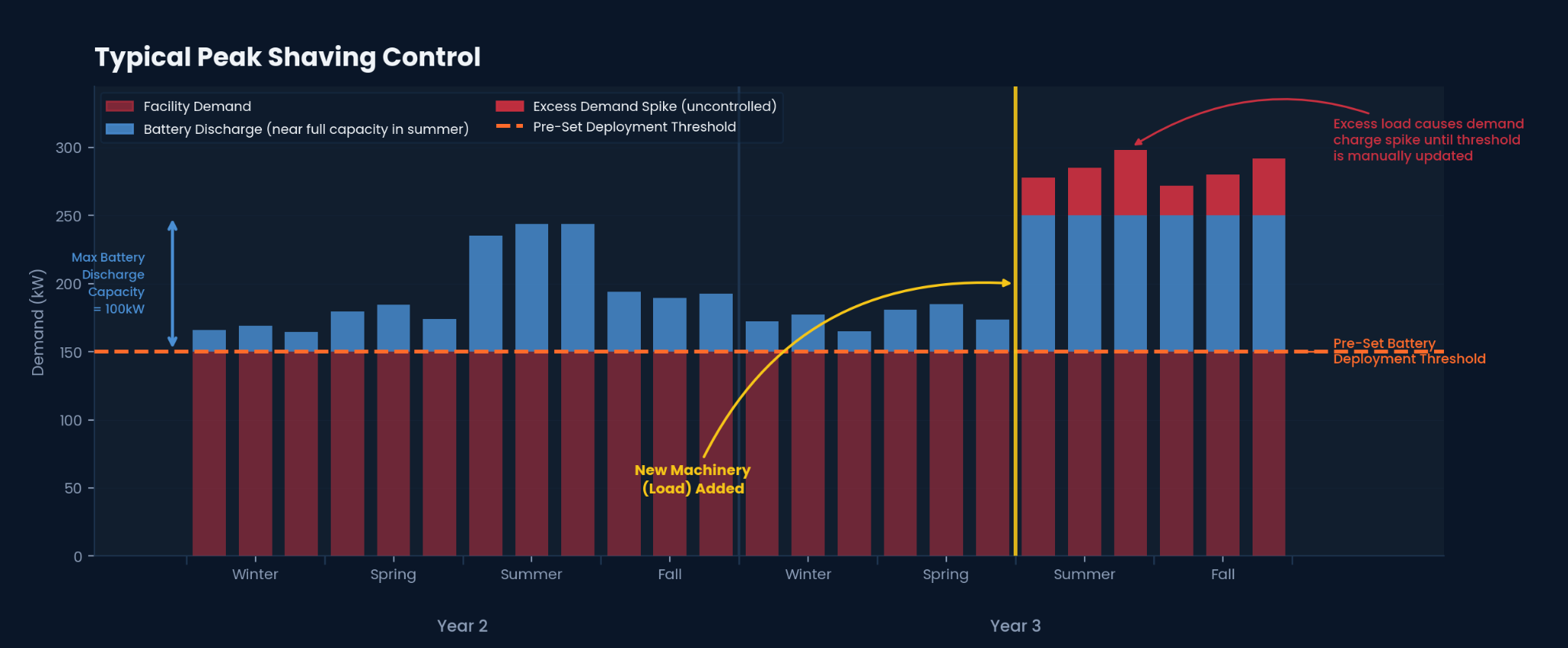
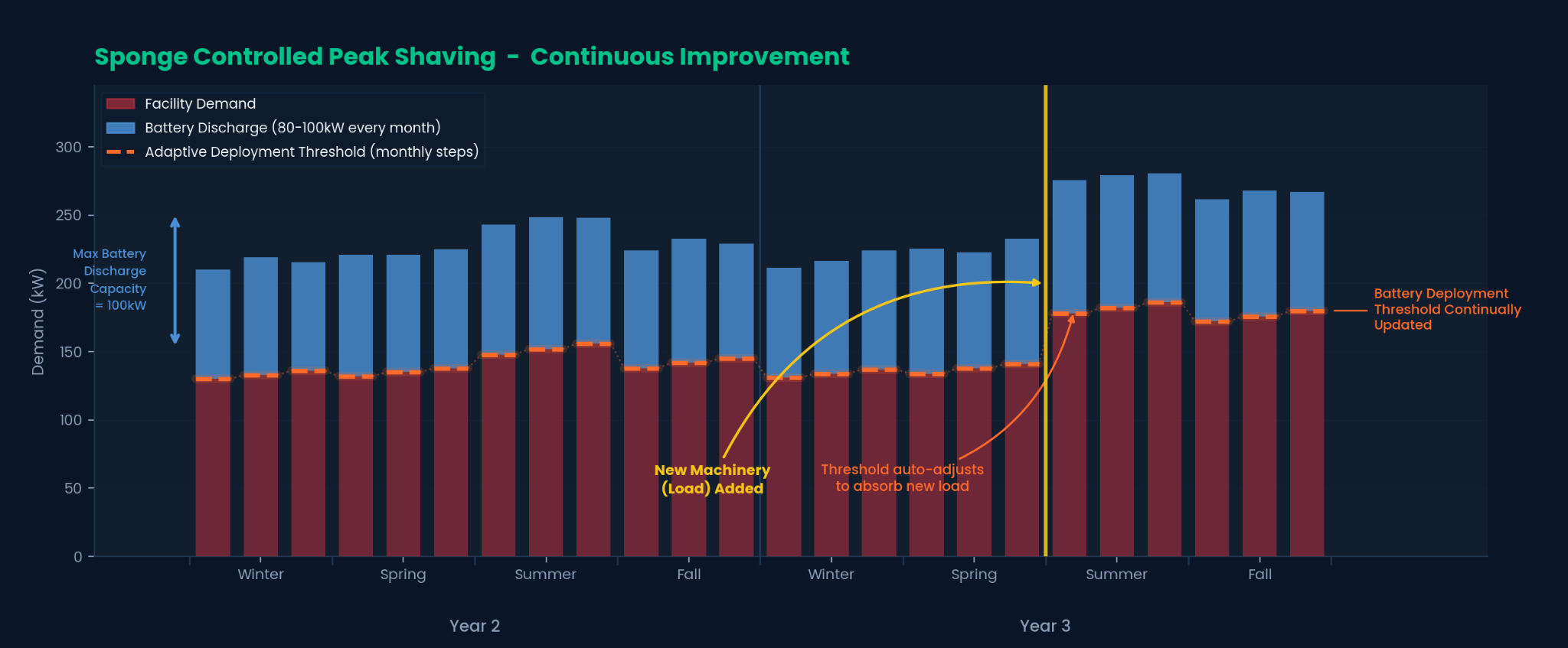
Sponge recalculates the threshold on each optimization cycle based on observed load and forecast for the remainder of the billing period — achieving the lowest defensible threshold given real conditions, without manual intervention.
The peak-ride-through problem
When unexpected load causes demand to approach or exceed the current threshold, a rules-based controller will discharge at maximum power until the battery is depleted — at which point demand spikes even higher than it would have without the battery. The MPC framework recognizes this failure mode in advance: if load begins to exhaust the battery more rapidly than set forth by the forecast, the controller raises the import threshold while it still has reserve energy, protecting the customer from the worst outcome.
3.3Illustrative economic comparison
The table below shows results from a representative Ontario Class B customer site simulation with zero-export (load displacement) solar and battery, comparing single-strategy controllers against the multi-objective Sponge approach. This scenario closely mirrors the functionality required for ESI use cases — demand charge management plus solar self-consumption with zero feed-in — but without the incentive and dispatch request components. Numbers are illustrative; project-specific economics for each unique site can be produced through our Proposal Service (see Section 06).
3.4Manual override and operator control
Automated optimization does not mean operator-opaque. Every dispatch decision is logged and displayed to the user via the future time-series power flow forecast in the Sponge monitoring platform. At any point, an EPC's O&M team or the end customer can manually override the MPC for any controlled piece of equipment via the Monitor Base web interface or the on-device touchscreen. Override events are scoped (time-bounded or indefinite) and the MPC resumes control automatically when the override clears.
Reliability and fail-safe architecture
The 85% ESI response threshold and the demand-charge ride-through requirement both place reliability at the center of the controller's value proposition. Sponge's reliability posture is built on three layers.
4.1Edge-local autonomy
Optimization runs on the EMC itself, not in a cloud service. The controller requires an internet connection to receive ESI dispatch calls from Uplight and to pull updated weather forecasts, but dispatch decision-making does not stall if the connection is interrupted. In the event of a sustained outage, the EMC continues to optimize against the most recent known state of the world, and queues telemetry for transmission when the connection is restored. This is the single most important reliability decision in the architecture: it removes cloud availability from the critical path of dispatch execution.
4.2Hardware resilience — EMC Pro+
The Sponge optimization and control software runs on a certified industrial PC designed for continuous unattended operation in commercial and industrial environments. For ESI deployments, the EMC Pro+ package adds a cellular router with network passthrough to maintain DERMS connectivity independent of the site LAN, a managed network switch for downstream equipment, and up to 6 RS485 ports for Modbus device communication. For sites over 5 MW where BC Hydro requires redundant endpoints, a second cellular modem and SIM can be specified. The EMC Pro+ can be housed in a NEMA 12 enclosure or integrated into the EPC's site control cabinet, with an optional UPS where design warrants it.
4.3Watchdog functionality
The EMC implements two layers of watchdog protection.
- ▸Internal process watchdog. A two-layer internal watchdog monitors the health of the EMC's software processes and restarts them automatically if they hang or become unresponsive. This is the primary line of defense for keeping the controller alive without external intervention, so that dispatch events are not missed and demand thresholds continue to be managed. Standard on every EMC.
- ▸External safe-state watchdog. For projects where a discrete fail-safe action is required in the event of a controller failure — for example, reducing inverter power output to enforce zero-export compliance on a load-displacement solar site — an additional external watchdog device can be deployed. The appropriate fail-safe behavior is defined during the site-specific design phase, as it depends on the project's constraints and which failure modes carry the greatest risk.
Hardware: EMC Pro+ for ESI deployments
For ESI-enrolled projects in the 1–5 MW class, Sponge proposes the EMC Pro+ hardware package. The configuration below is the project-specific hardware scope for ESI deployments. It is built on the standard EMC Pro+ platform with the specific components and options appropriate to this program.
Beyond the project-specific configuration above, every Sponge EMC Pro+ includes the standard platform features: integrated touchscreen, passive cooling, 10-year local data storage, PoE and Wi-Fi in addition to wired Ethernet. If a BC Hydro SCADA interface is required at the site, Uplight recommends the CradlePoint R920 with NetCloud Mobile Essential Service or other SCADA-compliant gateways such as the Advantech 3241 Industrial Router.
5.1Inverter and battery compatibility
The Sponge EMC communicates with inverters and battery systems over Modbus RTU (RS485), Modbus TCP, or other local APIs where supported. Native integrations are available for the majority of leading solar and battery inverter brands, with new OEM integrations built on request as part of project feasibility through our standardized integration onboarding process. Custom integrations are also available for load control (relays, smart switches) and EV charging equipment.
For the 1–5 MW class, the practical implication is that EPCs are not locked into a specific inverter or battery supply chain to deploy Sponge. This is a meaningful difference from EMS products that ship tightly bundled with one or two specific storage vendors.
Engagement model and next steps
6.1What Sponge delivers on every project
Across the lifecycle of a given site, Sponge's role slots alongside standard EPC workflow. The diagram below shows where Sponge activities support each phase of project delivery; these activities are included as part of Sponge's scope on every project, not optional add-ons.
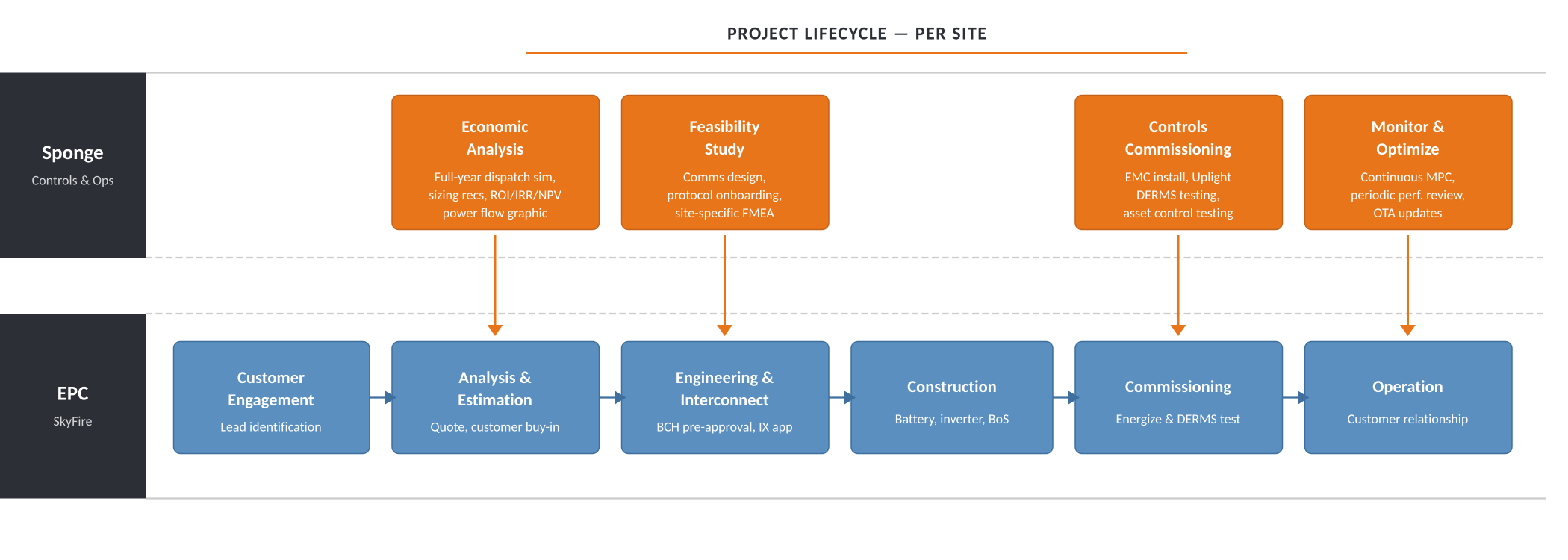
Summary of Sponge's per-project deliverables:
- ▸Project economic analysis based on Sponge dispatch algorithm performance over real client interval data.
- ▸Site-specific design and feasibility study, including comms architecture.
- ▸Commissioning, testing, and verification — including ESI DERMS connectivity testing and asset control testing with Uplight.
- ▸Monitoring, continuous optimization, and O&M support via Monitor Base, with scheduled periodic performance review of all fielded systems.
- ▸Scheduled site reviews and over-the-air EMC firmware updates.
- ▸Technical support commitment with a direct line to senior technical staff.
6.2Suggested immediate next steps
A 30 to 60 minute review call to walk through the first project and the project development process. Commercial terms follow under separate cover once scope is aligned.
ESI is a ten-year program with hard compliance gates. The controller you choose decides whether the project earns the incentive, captures the demand-charge stack, and survives the operational drift that kills static-threshold deployments. Sponge is built for all three.
Appendix A · Supporting Materials
Companion resources referenced throughout this document. Available for download and reuse on ESI proposals.
Next Step
Book a 30-minute ESI review call
Walk through your first ESI project with our team. We'll cover site economics, the BC Hydro enrollment workflow, and what the controller deployment looks like end to end.
Book a review call →